




Tibetan calligraphy is an art form in which the written word becomes an expression of beauty, discipline, and cultural heritage. For more than a thousand years, Tibetan scribes, scholars, monks, and artists have employed carefully crafted writing instruments, handmade papers, and traditional inks to record everything from Buddhist scriptures and philosophical treatises to poetry, historical chronicles, and everyday correspondence.
The beauty of Tibetan calligraphy lies not only in its distinctive letterforms but also in the remarkable relationship between the calligrapher and the materials used to create them. The angle of a bamboo pen, the consistency of an ink mixture, and the texture of a sheet of handmade paper all influence the character of the finished work. Each contributes to the rhythm, weight, and expressive quality of the written line.
These materials and techniques developed alongside Tibet’s rich literary and spiritual traditions, becoming essential elements of a manuscript culture responsible for preserving an extraordinary body of Buddhist knowledge.
To understand Tibetan calligraphy, therefore, is to appreciate more than the appearance of its letters. It is to explore the tools, craftsmanship, and traditions that have shaped this remarkable art over the centuries.
The Traditional Tibetan Calligraphy Pen
Among the most recognizable tools of Tibetan calligraphy is the traditional bamboo or reed pen. Unlike modern fountain pens or brushes, these writing instruments employ a carefully shaped, relatively rigid nib capable of producing the bold horizontal strokes, fine vertical lines, and graceful curves characteristic of Tibetan scripts.
The pen’s construction is deceptively simple. A length of suitable bamboo or reed is cut, trimmed, and shaped to create a writing edge. Yet subtle variations in the nib’s width, angle, and flexibility can profoundly affect the resulting letterforms.
The Importance of the Nib
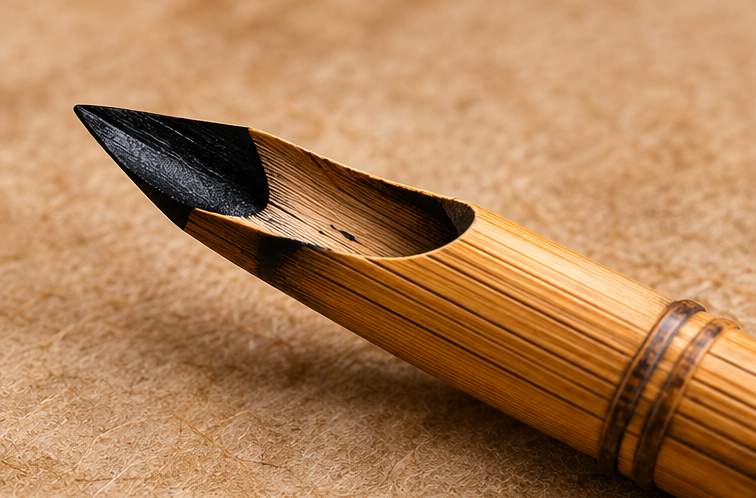
The distinctive appearance of Tibetan calligraphy depends heavily on the relationship between the pen’s broad writing edge and the direction of each stroke.
When held at an appropriate angle, the nib produces thick and thin lines without requiring dramatic changes in pressure. A broad stroke may emerge from a horizontal movement, while a delicate taper appears as the pen changes direction or gradually lifts from the paper.
This relationship is especially evident in Uchen, the formal headed style of Tibetan writing. Its characteristic horizontal headstrokes, carefully balanced vertical elements, and elegantly shaped lower forms require considerable control over the writing instrument.
Traditional calligraphers may prepare pens of different widths for different purposes. A narrow nib is suitable for smaller manuscripts and detailed writing, while broader nibs accommodate larger lettering, decorative inscriptions, and expressive compositions.
The process of preparing and maintaining a pen is itself an important aspect of the craft. A poorly shaped nib can produce irregular strokes, interrupt the flow of ink, or catch on the fibers of handmade paper. A carefully prepared instrument, by contrast, allows the calligrapher to work with greater consistency and precision.
Bamboo, Reed, and Other Writing Instruments
Bamboo and reed are particularly well suited to calligraphy because their natural structure provides a useful combination of rigidity, resilience, and workability.
However, Tibetan writing traditions have employed a variety of instruments, reflecting differences in region, historical period, availability of materials, and writing style.
Some instruments are designed for the formal precision of manuscript production, while others accommodate the quicker, more fluid movements associated with cursive writing.
In contemporary practice, Tibetan calligraphers also use metal-nib pens, brushes, and other modern instruments. Nevertheless, traditional bamboo and reed pens remain closely associated with the physical character of classical Tibetan lettering.
Their appeal lies partly in their simplicity. The calligrapher works directly with the natural properties of the material, developing an intimate understanding of how the instrument responds to movement, pressure, and ink.
Traditional Tibetan Ink
Ink is another essential element of Tibetan calligraphy, and its preparation has historically required considerable care.
Black ink has long been central to Tibetan manuscript production, providing the strong contrast necessary for legible writing on light-colored paper. Traditional formulations commonly employed carbon-rich pigments, including soot or lampblack, combined with liquid and suitable binding substances.
The precise ingredients and preparation methods varied according to local practices and the materials available.
Carbon-Based Inks
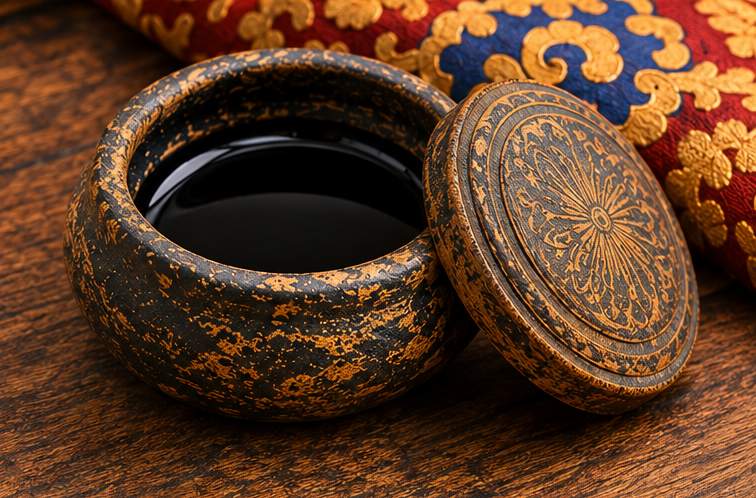
Carbon black is a particularly useful pigment for manuscript production because of its deep color and relative chemical stability.
Fine particles of soot can be collected from the controlled burning of oils or other combustible materials. Once gathered, the pigment is processed and combined with a binding medium to produce an ink capable of adhering to the writing surface.
The resulting mixture must strike a balance between several qualities.
It should flow smoothly from the pen without spreading excessively across the paper. It must be sufficiently concentrated to produce rich, dark strokes, yet fluid enough to accommodate delicate details and changes in direction.
An overly thick ink may interrupt the movement of the pen or create uneven deposits of pigment. An excessively thin mixture may produce weak strokes or penetrate too deeply into the paper.
The preparation of ink therefore involves an understanding of both the pigment itself and the surface upon which it will be applied.
The Use of Red and Colored Inks
Although black ink predominates in many Tibetan manuscripts, red ink has also played an important role in Tibetan literary and religious traditions.
Red may be used for headings, titles, structural divisions, and selected passages, helping distinguish important elements within a text.
In some manuscripts, colored inks and decorative pigments contribute to elaborate presentations of sacred writings. Gold and silver lettering, particularly when applied to dark manuscript surfaces, can create striking visual effects.
Such manuscripts demonstrate that Tibetan calligraphy has never been limited to purely functional writing. The selection of pigments, colors, and decorative techniques can transform a written text into an object of considerable artistic and devotional significance.
Traditional Tibetan Handmade Paper
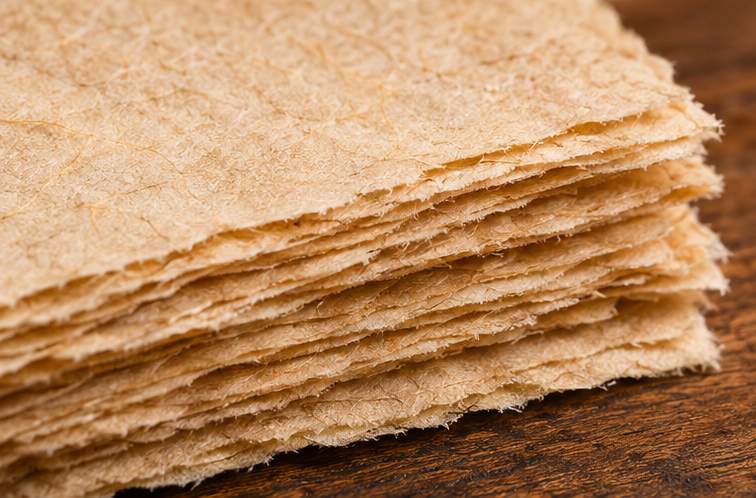
Perhaps no material is more closely connected to Tibet’s manuscript heritage than handmade paper.
For centuries, Tibetan papermakers developed techniques for transforming plant fibers into durable writing surfaces capable of supporting the production and preservation of religious, historical, and literary texts.
The resulting papers possess qualities that distinguish them from many modern machine-made products. Their textures, thicknesses, colors, and surface characteristics reflect the plants from which they are produced and the methods employed in their manufacture.
Traditional Tibetan papers are often remarkably strong, with long fibers that contribute to their durability and resistance to tearing.
The Plants Behind Tibetan Paper
Historical Tibetan papermaking has relied on several types of fibrous plants, particularly species belonging to the Daphne, Edgeworthia, and related groups.
These plants contain strong bast fibers that can be processed into pulp suitable for handmade paper.
The inner bark is separated from unwanted outer material, softened through soaking and cooking, and mechanically worked to loosen and distribute the fibers.
The prepared pulp is then suspended in water and formed into sheets using traditional papermaking equipment.
The exact process varies among papermaking traditions, and not all Himalayan handmade papers are produced using identical techniques.
Lokta paper, for example, is especially associated with Nepalese papermaking and is commonly made from the inner bark of Daphne species. Although it shares important material characteristics with some Tibetan papers, the two traditions should not be treated as interchangeable.
For those interested in the subject, our article on Traditional Tibetan Paper: The Ancient Craft Behind Tibet’s Sacred Manuscripts explores this remarkable heritage in greater depth.
Paper Texture and the Written Stroke
The relationship between paper and ink is especially important in calligraphy.
A paper’s absorbency determines how readily ink penetrates its surface, while its texture influences the movement of the pen and the appearance of individual strokes.
Highly absorbent paper may cause ink to spread beyond the intended boundaries of a letter, producing a feathered appearance. A more controlled surface can preserve the crisp edges and fine details essential to formal Tibetan scripts.
The sizing of paper, treating it to regulate liquid absorption, can therefore be an important consideration.
Different papermaking traditions have employed various methods of surface preparation, polishing, and sizing. These treatments influence not only how the paper accepts ink but also its smoothness, flexibility, and overall writing characteristics.
For a calligrapher, selecting paper is consequently much more than choosing an attractive background. It is an essential part of determining how the finished work will look and feel.
The Enduring Appeal of Handmade Paper
Handmade paper possesses an individuality that is difficult to reproduce through industrial manufacturing.
Its subtle irregularities, visible fibers, and naturally varied surfaces create a tactile connection between the artist and the material.
A sheet may be unusually smooth or delicately textured, thin and translucent or substantial and opaque. Its color may range from pale ivory to warm cream or deeper earthy tones.
These variations can become integral to a calligraphic composition.
In traditional manuscript production, paper was also valued for its practical qualities. Strong, well-prepared sheets could withstand repeated handling and, under favorable storage conditions, survive for generations.
The preservation of centuries-old Tibetan manuscripts is a testament not only to the dedication of their scribes but also to the remarkable craftsmanship of the papermakers who supplied their writing materials.
The Pecha: Tibet’s Traditional Manuscript Format
One of the most distinctive features of Tibetan manuscript culture is the pecha, the traditional loose-leaf book format widely associated with Tibetan Buddhist literature.
Unlike the bound books familiar to modern Western readers, a pecha generally consists of long, rectangular sheets arranged in a stack.
The format reflects the influence of Indian manuscript traditions, particularly the elongated palm-leaf manuscripts used to preserve Buddhist and other literary works.
As Buddhism spread into Tibet, this format was adapted to locally available writing materials and became deeply established within Tibetan literary culture.
The Structure of a Pecha
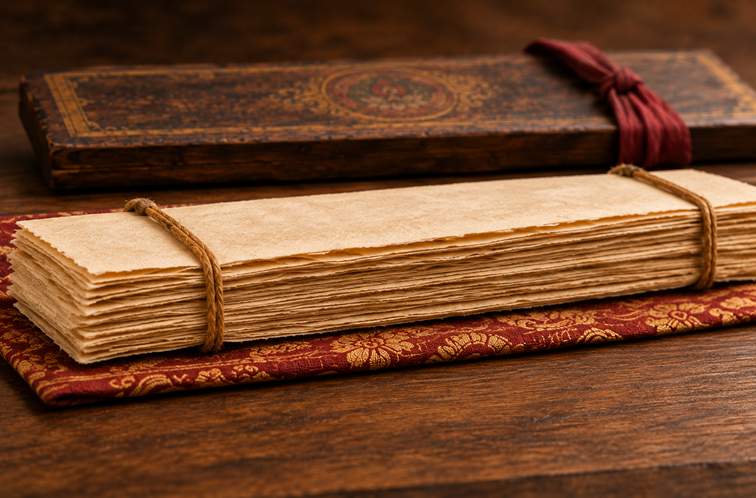
Traditional pecha pages are typically wider than they are tall, providing a distinctive horizontal writing surface.
Text is arranged in lines across the page, with dimensions and layout varying according to the manuscript’s purpose, period, and place of production.
The individual sheets are generally not sewn together along a spine. Instead, they are stacked in sequence and may be protected between wooden boards, wrapped in cloth, and secured with ties.
This arrangement makes the pecha visually recognizable and gives it a character quite different from that of a conventional codex.
Manuscript Covers and Wrappings
The preservation of Tibetan manuscripts has often involved carefully crafted protective materials.
Wooden covers may be plain or elaborately carved and painted. Cloth wrappings, sometimes made from richly colored textiles, help protect the pages from dust, light, and physical damage.
These elements also contribute to the visual and ceremonial presence of the manuscript.
In religious settings, a carefully wrapped pecha may be treated as more than a repository of information. It can represent a sacred object worthy of respect because of the teachings it contains.
The relationship between the written text, its physical materials, and the traditions surrounding its care is a defining feature of Tibetan manuscript culture.
Tibetan Calligraphy and the Preservation of Buddhist Teachings
The history of Tibetan calligraphy cannot be separated from the transmission of Buddhism into Tibet.
Beginning in the seventh century and expanding considerably during subsequent centuries, the translation and preservation of Buddhist literature became major undertakings.
Tibetan scholars and translators worked to render extensive bodies of Indian Buddhist literature into Tibetan, creating a literary heritage of extraordinary scope.
The production of manuscripts was essential to this effort.
Before the widespread availability of printed texts, copying by hand was among the principal means of reproducing and transmitting written teachings. Scribes played a vital role in preserving scriptures, philosophical commentaries, ritual instructions, and other works for future generations.
Writing as an Act of Devotion
Within Tibetan Buddhist traditions, the copying of sacred texts could carry religious significance beyond the practical task of reproducing words. The creation, sponsorship, and preservation of Buddhist scriptures have often been regarded as meritorious activities. A manuscript might be commissioned as an offering, produced to support religious study, or created as an expression of devotion. The care devoted to its production could reflect the importance attributed to the teachings themselves.
This devotional dimension is especially apparent in elaborate manuscripts featuring gold lettering, decorative borders, carefully prepared surfaces, and richly ornamented covers. Such works demonstrate how manuscript production could bring together religious intention and exceptional artistic craftsmanship.
The Calligrapher’s Relationship to the Text
For practitioners working with Buddhist material, calligraphy can also provide an opportunity for contemplation.
The deliberate formation of each letter encourages sustained attention, while the words being written may carry philosophical or spiritual significance.
A mantra, verse, or passage from a Buddhist teaching can become the subject of both artistic expression and personal reflection.
This does not mean that every historical Tibetan scribe approached writing as a meditative exercise. Much manuscript production involved demanding, practical labor.
Nevertheless, the relationship between writing, attention, and devotional intention remains an important dimension of Tibetan calligraphy, particularly in contemporary artistic practice.
The Craftsmanship Behind Tibetan Manuscript Production
The creation of a traditional manuscript frequently involved the work of more than one skilled craftsperson.
Papermakers prepared the writing surfaces, scribes copied the texts, and other artisans might contribute illustrations, decorative elements, wooden covers, or protective wrappings.
Large manuscript projects could require considerable resources and coordination.
Preparing the Writing Surface
Before writing could begin, paper needed to be suitable for the intended script and ink.
Depending on the material and tradition, preparation might involve smoothing, polishing, or other treatments designed to improve the writing surface.
The quality of the paper influenced both the ease of writing and the appearance of the completed manuscript.
A smooth, properly prepared surface could accommodate fine details and controlled strokes, while irregular or excessively absorbent paper might make precise lettering more difficult.
Laying Out the Manuscript
The arrangement of text on the page was another important consideration. Margins, line spacing, and the placement of headings needed to be established before or during the writing process. Some manuscripts incorporated ruling lines or other layout guides to help maintain consistent alignment.
The dimensions of the pecha format required particular attention to the horizontal organization of the text. In more elaborate works, spaces might also be reserved for illustrations, decorative initials, or other visual elements.
The Scribe’s Responsibility
Accuracy was essential when copying religious and philosophical texts. An omitted syllable, misplaced character, or incorrectly reproduced passage could alter the meaning of the material. Scribes therefore needed not only calligraphic skill but also careful attention to the text itself.
The transmission of Tibetan Buddhist literature depended upon generations of individuals who undertook this demanding work. Their manuscripts became part of a vast cultural inheritance, preserving works that continue to be studied, translated, and practiced today.
Woodblock Printing and the Evolution of Tibetan Book Culture
Although handwritten manuscripts occupy a central place in Tibetan calligraphic history, woodblock printing also became an important means of reproducing texts.
In this process, a page of writing was transferred or prepared for carving into a wooden block. The raised printing surfaces were then inked and pressed against paper to produce multiple copies.
Woodblock printing enabled the reproduction of extensive religious collections and helped expand access to written teachings.
The development of printing did not eliminate the importance of calligraphy.
Instead, carefully formed Tibetan lettering remained fundamental to the preparation of printing blocks.
The relationship between handwriting and printing contributed to the standardization and transmission of Tibetan letterforms while preserving many of their traditional visual characteristics.
Some of the most important collections of Tibetan Buddhist literature, including editions of the Kangyur and Tengyur, were reproduced through woodblock printing.
These collections represent monumental achievements in Tibetan literary and religious history.
The Survival of Traditional Tibetan Calligraphy
The tools and traditions of Tibetan calligraphy have undergone significant changes in the modern era. Printed books, digital typography, and electronic communication have transformed the ways Tibetan is written, reproduced, and distributed.
Today, Tibetan script appears on computer screens and mobile devices, in digital publications, and across a wide variety of contemporary media. Yet traditional calligraphy continues to occupy an important place within Tibetan artistic and cultural life.
Calligraphers preserve classical writing styles, experiment with new compositions, and adapt traditional techniques to contemporary forms of artistic expression.
Traditional Materials in Contemporary Practice
Modern calligraphers have access to a much wider range of materials than their historical predecessors. Commercial inks, manufactured papers, metal-nib pens, and other contemporary tools offer practical alternatives to traditional equipment. At the same time, many artists remain drawn to handmade paper and natural writing instruments because of their distinctive physical qualities.
The slight resistance of a bamboo nib against a textured surface, the subtle variations in a handmade sheet, and the richness of traditional black ink can contribute to an experience of writing that differs substantially from working with modern manufactured materials. These qualities are not merely nostalgic. They can directly influence the appearance and character of the artwork.
Preserving a Living Tradition
The continued practice of Tibetan calligraphy represents more than the preservation of historical techniques.
It is also a means of sustaining a living connection to Tibetan language, literature, and cultural identity.
Through the study of traditional scripts and materials, contemporary artists engage with forms of knowledge developed and refined over many generations. At the same time, calligraphy remains open to creative exploration.
New compositions, unconventional formats, and contemporary artistic influences can coexist with a deep respect for established forms. In this way, Tibetan calligraphy continues to evolve while maintaining its connection to the traditions from which it emerged.
Tibetan Calligraphy as Art and Contemplative Practice
One of the most compelling aspects of Tibetan calligraphy is the way it brings together technical discipline and artistic expression. The act of writing requires coordination between the eye, hand, and mind. Each stroke demands attention to its direction, pressure, proportion, and relationship to the surrounding forms.
The materials themselves introduce an additional dimension of awareness. The pen responds to movement, the ink interacts with the paper, and the surface offers its own particular texture and resistance. Rather than functioning as passive tools, these materials become active participants in the creation of the work.
For artists inspired by Buddhist philosophy and contemplative traditions, this process can also become an opportunity to cultivate patience, concentration, and presence. The finished calligraphy may communicate a teaching or express an idea, but its creation can be meaningful in its own right.
The gradual formation of letters becomes a meeting point between craftsmanship and contemplation.
The Enduring Beauty of Tibetan Calligraphy
The tools and traditions of Tibetan calligraphy reveal a remarkable history of artistic innovation, material knowledge, and cultural preservation.
From the carefully shaped bamboo pen to the fibrous surface of handmade Himalayan paper, every element contributes to the distinctive character of the written word. These materials supported the creation of manuscripts that preserved Buddhist teachings, philosophical works, poetry, and historical records across many centuries. They also gave rise to an artistic tradition in which the form of a letter could become an object of beauty in its own right.
Today, the continued use and exploration of traditional techniques offer a meaningful connection to that heritage.
At Sambhota Studio, this enduring tradition serves as both an artistic inspiration and a subject of ongoing exploration. Through original calligraphy and educational resources, the hope is to encourage a deeper appreciation of Tibetan writing, its extraordinary manuscript culture, and the craftsmanship that has sustained it for generations.
The tools may be simple, a pen, ink, and paper, but the tradition they embody is one of extraordinary richness, creativity, and cultural significance.
